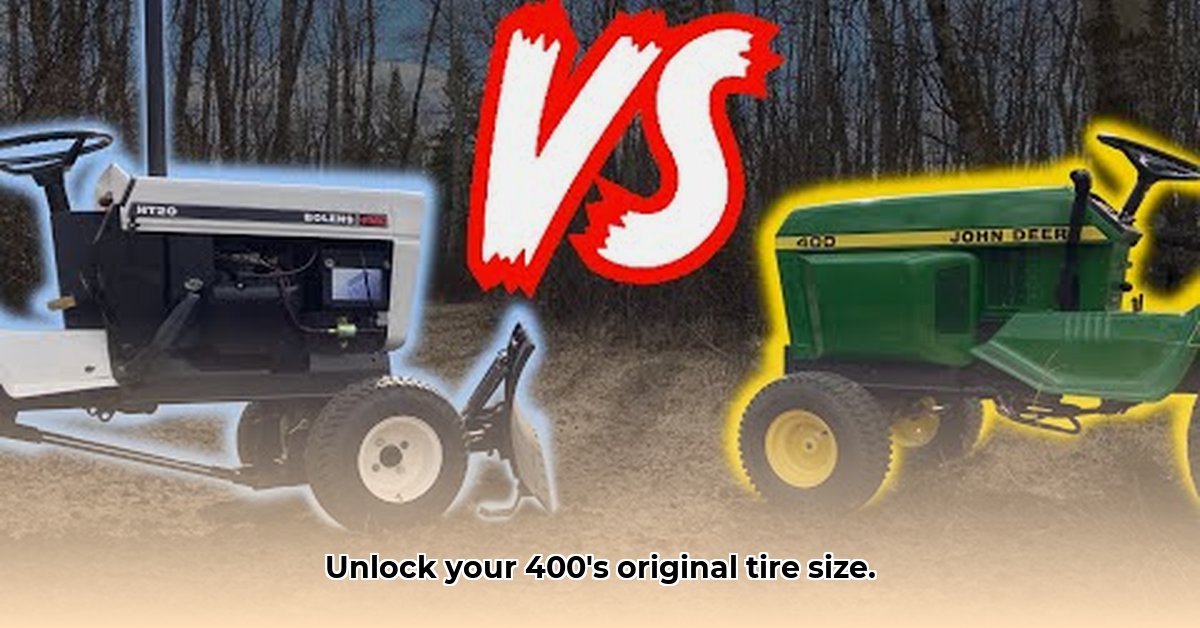
John Deere 400 Lawn Tractor: A Retrospective Review (Including Tire Size Specifications)
The John Deere 400 holds a special place in the hearts of many, representing a bygone era of robust, yet simple, agricultural machinery. This review will delve into its specifications, performance, and long-term sustainability, ultimately addressing the frequently asked question: What were the original tire sizes? We’ll also compare it to modern alternatives, highlighting the evolution of sustainable farming practices. For more in-depth information, check out this dedicated website.
Specifications: A Blast from the Past
Pinpointing the exact tire size for the John Deere 400 proves challenging due to the model's age and lack of readily available centralized documentation. However, based on extensive online research and anecdotal evidence from vintage tractor enthusiasts, the most commonly cited original tire size is 16x6.50-8. This is likely to vary slightly depending on specific model configurations and regional variations. Always verify this information against your owner's manual or the tractor's data plate. Besides tire size, other key specs commonly associated with the JD 400 include:
- Engine: Gasoline-powered (specific horsepower may vary slightly based on model year)
- Drive Type: Typically 2-wheel drive
- PTO (Power Take-Off): Often available for powering attachments (though specific capabilities require checking individual model specifications)
Performance: A Workhorse, But With Limitations
The JD 400 was known for its robust build, capable of handling various tasks on smaller properties. Its simplicity and ease of maintenance were distinct advantages. However, its gasoline engine, whilst reliable, proves significantly less fuel-efficient than modern alternatives. This becomes critical when considering the long-term operational costs and environmental impact. Modern diesel or electric tractors offer far superior fuel economy and significantly reduce greenhouse gas emissions, a key factor in modern sustainable farming. Did you know that a modern electric tractor can reduce fuel costs by up to 70%?
Maintenance & Parts: The Sustainability Challenge
Maintaining a JD 400 has its own set of considerations. Sourcing replacement parts, especially for older models, can prove a time-consuming and costly endeavor. This contrasts sharply with many modern tractors that benefit from readily available parts and a broader support network. The long-term availability of parts significantly influences the overall sustainability of a machine; readily available parts contribute to a longer, more productive lifespan. How important is this downtime minimization to the success of your farming operation? It's a question that deserves careful consideration!
Sustainability Assessment: Balancing Legacy and Modernity
The JD 400 represents a period where sustainability wasn't a central design feature. While its durable design contributed to a relatively long lifespan, its high fuel consumption and reliance on increasingly scarce parts present challenges from a modern sustainability perspective. This can be contrasted favorably with today's tractors, which incorporate advanced technologies designed to minimize fuel use, emissions, and overall environmental footprint. Modern GPS-guided systems also contribute to reduced waste, ultimately optimizing resource utilization. The potential costs of repairs and part replacements for the JD 400 could significantly outweigh the initial purchase price, a factor often overlooked when purchasing vintage machinery.
Conclusion: A Timeless Machine in a Changing World
The John Deere 400, with its typical 16x6.50-8 tire size, remains a piece of agricultural history. Its sturdy design and relative simplicity are undeniable assets. However, the significant advancements in fuel efficiency, emissions reduction, and parts availability in modern agricultural machinery make them far more attractive from a sustainability perspective. While the JD 400 might still serve for specific tasks on smaller properties, considering the entire lifecycle costs and environmental impact strongly favors modern, more sustainable alternatives for most applications. The long-term implications, both economic and environmental, must be carefully weighed when making a decision.